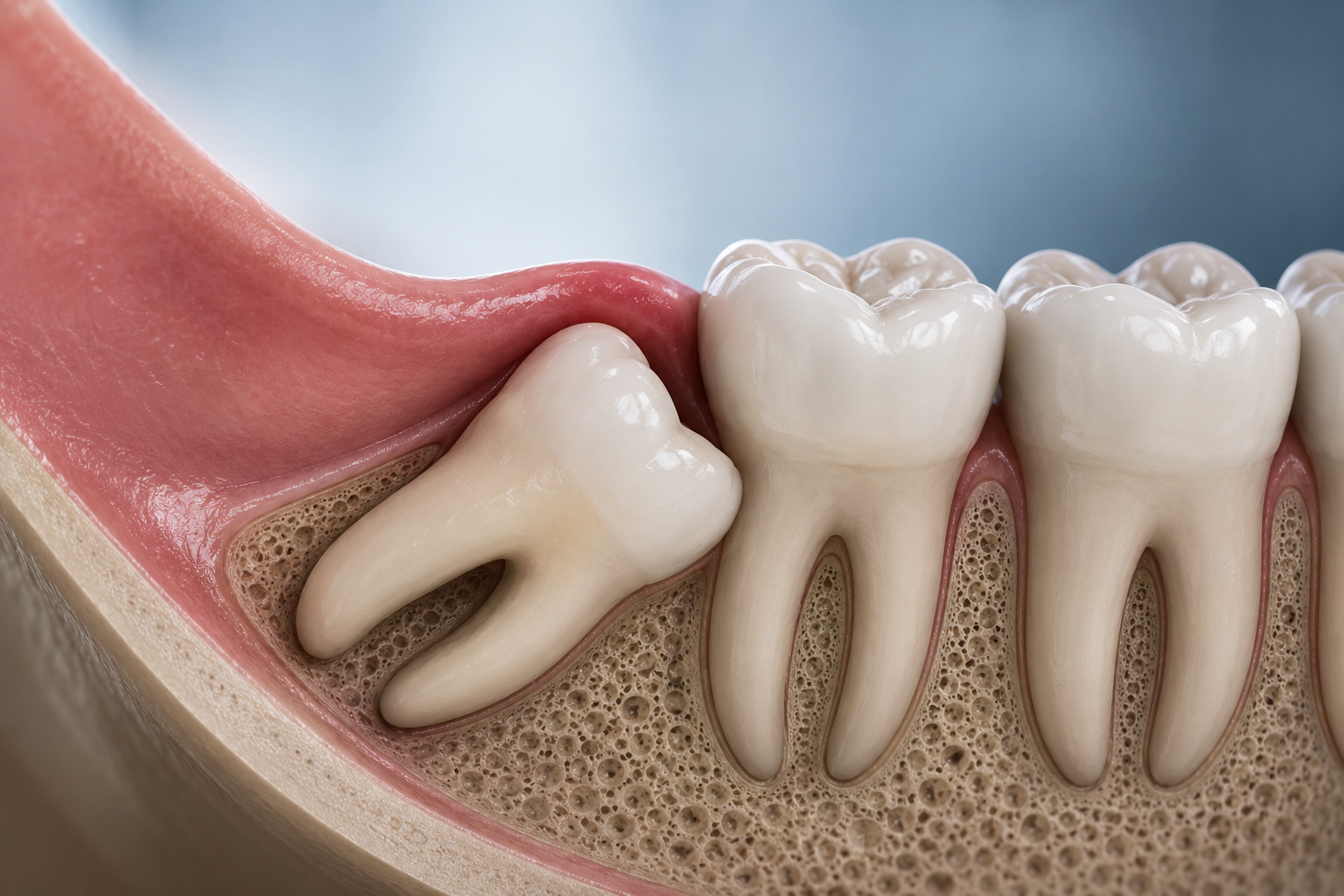
Wisdom teeth, also known as third molars, are the last permanent teeth to develop and usually begin to erupt during the late teenage years or early adulthood.
Not every wisdom tooth needs to be removed. If a wisdom tooth has erupted normally, can be cleaned effectively and is not causing problems with the surrounding teeth or tissues, extraction may not be necessary.
However, wisdom teeth that are impacted, partially erupted or positioned incorrectly can sometimes cause pain, infection, decay or damage to neighbouring teeth. In these situations, wisdom tooth removal may be recommended after clinical and radiographic evaluation.
What Is an Impacted Wisdom Tooth?
An impacted wisdom tooth is a tooth that cannot fully erupt into its normal position in the mouth.
This may happen because there is not enough space in the jaw, the tooth is positioned at an angle or its eruption is blocked by another tooth or surrounding bone.
Wisdom teeth may be:
- completely impacted beneath the gum or bone,
- partially erupted,
- angled towards the neighbouring tooth,
- or positioned in another direction that prevents normal eruption.
An impacted wisdom tooth does not automatically need to be removed. The decision depends on its position, symptoms and potential effect on surrounding structures.
When Does a Wisdom Tooth Need to Be Removed?
Wisdom tooth extraction may be considered when the tooth is associated with problems such as:
- recurrent pain or tenderness,
- repeated inflammation or infection around the tooth,
- swelling of the surrounding gum,
- difficulty cleaning the area,
- decay in the wisdom tooth,
- decay or damage affecting the neighbouring second molar,
- periodontal problems around the neighbouring tooth,
- certain cystic or pathological changes,
- or other clinical problems related to the position of the tooth.
The presence of a wisdom tooth alone is not necessarily an indication for extraction.
Does Every Impacted Wisdom Tooth Need to Be Removed?
No.
Some impacted wisdom teeth remain asymptomatic and do not cause detectable disease. In these situations, the dentist may recommend clinical and radiographic monitoring rather than immediate removal.
The decision should be based on the individual tooth rather than a general rule that all impacted wisdom teeth must be extracted.
Age, tooth position, available space, oral hygiene, symptoms and the condition of the neighbouring tooth can all influence the treatment decision.
What Are the Symptoms of a Problematic Wisdom Tooth?
A problematic wisdom tooth may cause:
- pain at the back of the jaw,
- swollen or tender gums,
- discomfort while chewing,
- difficulty opening the mouth in some cases,
- unpleasant taste or bad breath associated with local infection,
- recurrent inflammation around a partially erupted tooth,
- or swelling around the affected area.
However, some wisdom teeth can cause damage without producing significant symptoms.
For example, decay or periodontal problems can occasionally develop on the back surface of the neighbouring second molar.
This is why symptoms alone are not always sufficient to determine whether treatment is required.
What Is Pericoronitis?
Pericoronitis is inflammation of the gum tissue surrounding a partially erupted tooth and commonly occurs around lower wisdom teeth.
When part of the wisdom tooth remains covered by gum tissue, food and bacteria can accumulate underneath this area.
This may result in:
- pain,
- swelling,
- tenderness,
- unpleasant taste,
- difficulty chewing,
- and sometimes difficulty opening the mouth.
Recurrent episodes of pericoronitis are one of the reasons a dentist may consider wisdom tooth removal.
Can Wisdom Teeth Damage the Tooth Next to Them?
In some cases, yes.
An impacted or poorly positioned wisdom tooth can make the area between the wisdom tooth and the second molar difficult to clean.
This can contribute to:
- tooth decay,
- gum inflammation,
- periodontal bone loss,
- and, in selected cases, damage to the neighbouring tooth.
The relationship between the wisdom tooth and the second molar is therefore an important part of the examination.
How Is an Impacted Wisdom Tooth Evaluated?
The assessment usually begins with a clinical examination and dental X-ray.
A panoramic radiograph can provide information about:
- the position and angle of the wisdom tooth,
- its relationship with the neighbouring tooth,
- the surrounding bone,
- the shape and development of the roots,
- and its relationship with nearby anatomical structures.
For some lower impacted wisdom teeth, the roots may appear close to the inferior alveolar nerve canal.
When more detailed information is required, three-dimensional imaging such as CBCT may be considered.
CBCT is not necessary for every wisdom tooth extraction and should be used when clinically indicated.
Is Wisdom Tooth Removal Painful?
Wisdom tooth extraction is generally performed under local anaesthesia.
Once adequate anaesthesia has been achieved, the patient should not normally feel sharp pain during the procedure, although pressure and movement may be noticeable.
The complexity of the procedure depends on factors such as the position of the tooth, root anatomy and whether the tooth is partially or completely impacted.
What Should I Expect After Wisdom Tooth Removal?
Some discomfort, swelling and tenderness are common after wisdom tooth extraction, particularly after surgical removal of an impacted tooth.
The intensity and duration vary depending on the complexity of the procedure and individual healing response.
Following the dentist's postoperative instructions is important for normal healing.
Patients should contact their dentist if they experience unexpected or worsening symptoms after the procedure.
At What Age Should Wisdom Teeth Be Removed?
There is no single age at which every wisdom tooth should be removed.
Wisdom teeth are often evaluated during the late teenage years and early adulthood because this is when they commonly begin to erupt or become clinically relevant.
However, the indication for extraction should be based on the condition and position of the tooth rather than age alone.
A healthy wisdom tooth that is functioning normally does not necessarily need to be removed simply because a patient has reached a certain age.
Wisdom Tooth Removal in Bursa, Turkey
Whether a wisdom tooth should be removed depends on its position, symptoms and its relationship with the surrounding teeth and anatomical structures.
At Ante Dental Clinic in Nilüfer, Bursa, wisdom teeth can be evaluated through clinical examination and appropriate radiographic imaging. When extraction is indicated, the treatment approach is planned according to the position and anatomy of the individual tooth.
The objective is not to remove every wisdom tooth routinely, but to identify teeth that are causing problems or present a clinically relevant risk to surrounding structures.
Frequently Asked Questions
Do all wisdom teeth need to be removed?
No. Wisdom teeth that are healthy, functional and not causing problems may not require extraction.
Does an impacted wisdom tooth always need surgery?
Not necessarily. The procedure depends on how much of the tooth has erupted, its position and its relationship with the surrounding bone and tissues.
Can a wisdom tooth cause problems without pain?
Yes. Decay or periodontal problems affecting the neighbouring tooth can sometimes develop without significant symptoms.
Is a panoramic X-ray enough before wisdom tooth removal?
It is sufficient for assessment in many cases. If the tooth has a complex relationship with important anatomical structures, additional three-dimensional imaging may sometimes be considered.
Can wisdom teeth cause crowding of the front teeth?
Wisdom teeth have traditionally been blamed for late crowding of the lower front teeth, but crowding is multifactorial. The presence of wisdom teeth alone is generally not a sufficient reason for extraction solely to prevent anterior crowding.
When should I see a dentist about my wisdom tooth?
Pain, recurrent swelling, inflammation, difficulty cleaning the area or other symptoms around a wisdom tooth should be evaluated by a dentist.
Conclusion
Not every wisdom tooth needs to be removed.
The decision should be based on clinical findings, symptoms, radiographic evaluation and the effect of the tooth on neighbouring structures.
An impacted wisdom tooth that remains healthy and does not cause problems may sometimes be monitored, while a tooth associated with recurrent infection, decay or damage to adjacent structures may require removal.
Please note: This article is intended for general information and does not replace a dental examination, diagnosis or individual treatment plan.