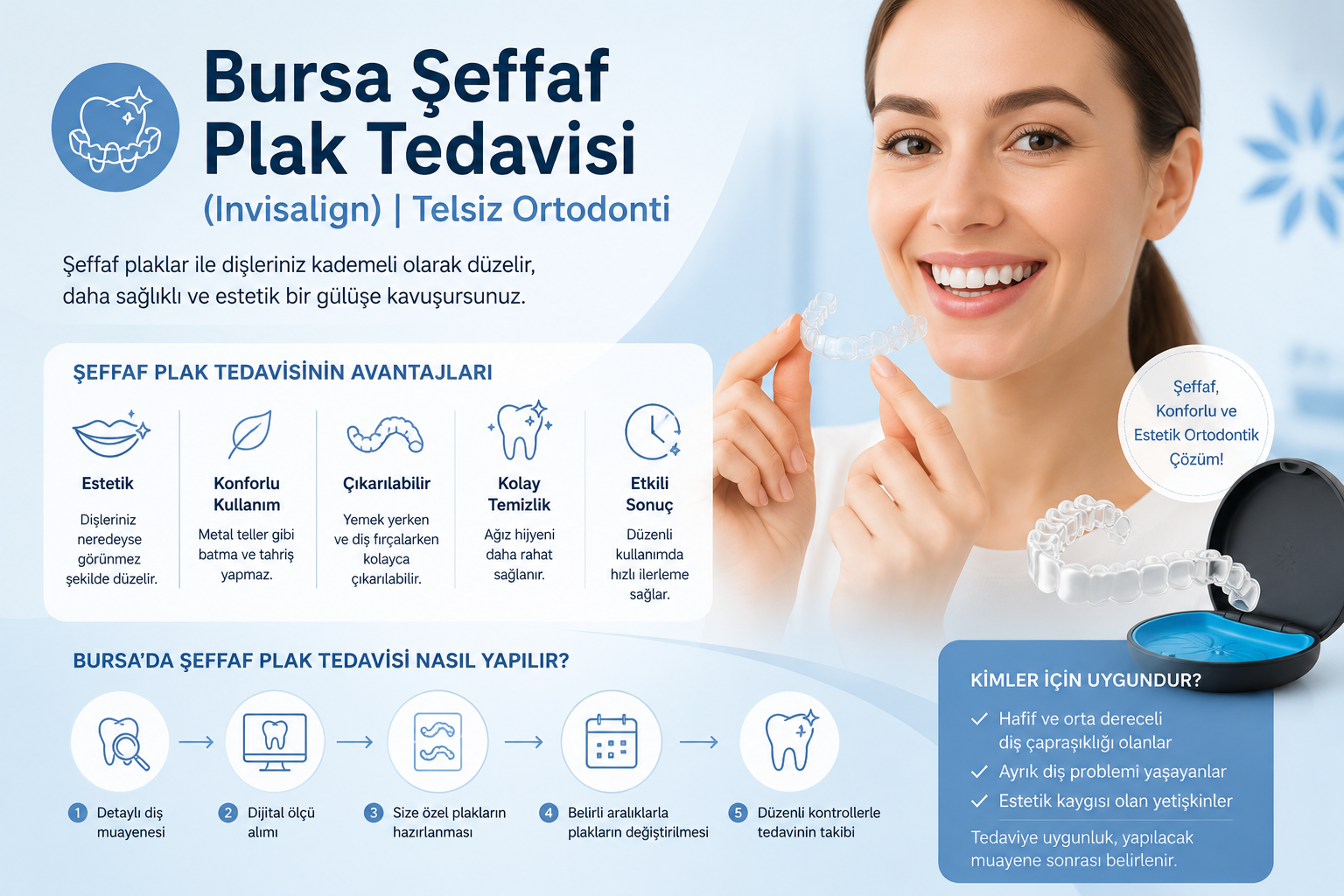
Clear aligner treatment is a modern orthodontic option used to correct crowding, spacing and certain bite problems without traditional fixed metal braces.
Clear aligners are transparent, removable appliances that are individually designed to move the teeth gradually into their planned positions. Systems such as Invisalign and other clear aligner technologies are particularly popular among patients who want a less noticeable orthodontic treatment.
At Ante Dental Clinic in Nilüfer, Bursa, clear aligner treatment is planned using digital intraoral scanning and computer-assisted treatment planning.
What Is Clear Aligner Treatment?
Clear aligner treatment uses a series of customised transparent aligners to move the teeth gradually.
Each aligner is designed to produce a small, controlled movement. Patients wear the aligners in sequence and change to the next set according to the treatment plan, commonly every one to two weeks depending on the system and the individual case.
Unlike fixed braces, clear aligners can be removed for eating, brushing and flossing.
How Do Clear Aligners Move Teeth?
Treatment generally begins with a clinical examination, photographs and a digital scan of the teeth.
The digital model is then used to plan the desired tooth movements. Specialised software allows the dentist to visualise the starting position of the teeth and the planned final result.
A series of aligners is produced according to this digital treatment plan.
Each aligner applies controlled forces to selected teeth. As treatment progresses, the teeth gradually move through the planned stages.
Regular clinical reviews are important to confirm that the teeth are tracking according to the digital plan. In some cases, additional aligners or refinements may be required.
Clear Aligners or Traditional Braces?
Both clear aligners and fixed braces can be effective orthodontic treatments, but they have different advantages.
Appearance
Clear aligners are transparent and are generally much less noticeable than conventional metal braces.
Comfort
Because there are no metal brackets or wires, clear aligners may cause less irritation to the cheeks and lips. Some pressure or temporary sensitivity can still occur when changing to a new aligner.
Removability
Aligners can be removed during meals and while brushing or flossing, which can make oral hygiene easier.
Fixed braces remain attached to the teeth throughout treatment.
Patient Compliance
One of the most important differences is patient cooperation.
Clear aligners only work effectively when they are worn for the recommended number of hours each day. Fixed braces do not depend on the patient remembering to wear the appliance.
Complex Orthodontic Problems
Clear aligner systems can treat many orthodontic problems, but some complex tooth movements or skeletal discrepancies may be better managed with fixed braces or a combined orthodontic approach.
The most appropriate treatment therefore depends on the individual case.
Who Is Suitable for Clear Aligner Treatment?
Clear aligner treatment may be considered for patients with:
- mild to moderate crowding,
- spaces between the teeth,
- certain mild to moderate bite problems,
- relapse after previous orthodontic treatment,
- aesthetic concerns about visible braces.
Clear aligners are widely used in adults and may also be suitable for selected adolescents.
However, suitability cannot be determined from appearance alone. The position of the teeth, bite, jaw relationship and periodontal health should all be evaluated before treatment.
What Are the Advantages of Clear Aligners?
Potential advantages include:
- discreet appearance,
- removable design,
- easier brushing and flossing compared with fixed appliances,
- fewer problems related to brackets and wires,
- digital treatment planning,
- the ability to visualise planned tooth movements before treatment.
However, these advantages do not mean clear aligners are automatically the best option for every patient.
The effectiveness of treatment depends heavily on correct case selection, treatment planning and regular aligner wear.
How Many Hours a Day Should Clear Aligners Be Worn?
Clear aligners are generally recommended to be worn for approximately 20–22 hours per day, although the exact protocol should follow the instructions provided for the individual treatment plan.
They are usually removed only for:
- eating,
- drinking beverages other than water,
- brushing,
- flossing.
Wearing the aligners for significantly fewer hours than recommended can delay tooth movement and extend the overall treatment time.
Can You Eat With Clear Aligners?
Clear aligners should normally be removed before eating.
Eating while wearing the aligners can damage or deform them and can also trap food between the aligner and the teeth.
After eating, the teeth should be cleaned before the aligners are reinserted whenever possible.
Can You Drink Coffee or Tea With Clear Aligners?
Hot or strongly coloured drinks such as coffee and tea are generally best consumed after removing the aligners.
Heat can affect some aligner materials, while pigments may stain the transparent plastic.
Water can normally be consumed while the aligners are in place.
How Should Clear Aligners Be Cleaned?
Aligners should be cleaned regularly according to the instructions provided by the dentist or aligner manufacturer.
In general, they can be rinsed with lukewarm water and gently cleaned with an appropriate soft brush or cleaning product.
Very hot water should be avoided because it may alter the shape of the aligner.
Good oral hygiene is equally important because plaque and food debris can become trapped beneath the aligners.
Digital Scanning for Clear Aligner Treatment
Digital intraoral scanning allows a three-dimensional model of the teeth to be created without conventional impression material in many cases.
During the scan, a small intraoral scanner captures the surfaces of the teeth and soft tissues.
Potential advantages include:
- improved patient comfort,
- immediate visualisation of the teeth,
- digital storage of the model,
- easier communication during treatment planning,
- integration with clear aligner planning software.
The digital model can then be used to plan tooth movements and manufacture the aligner series.
Why Is Digital Treatment Planning Important?
Clear aligner treatment is not simply a matter of producing transparent trays.
The success of the treatment depends on planning:
- which teeth should move,
- how much they should move,
- in which sequence they should move,
- whether attachments or other auxiliaries are required,
- how the bite should develop during treatment.
Digital planning allows these stages to be visualised before treatment begins.
However, the simulation should be understood as a treatment plan rather than a guaranteed representation of the final result. Biological response and patient compliance can affect actual tooth movement.
How Long Does Clear Aligner Treatment Take?
Treatment duration varies considerably according to the complexity of the case.
Some relatively simple cases may be completed within several months, while more complex orthodontic treatment can take considerably longer.
In many cases, treatment may take approximately 6–18 months, but this is only a general range.
The number of aligners, the type of tooth movement required and the patient's compliance all influence the total treatment time.
Additional refinement aligners may also extend treatment.
Do Clear Aligners Hurt?
Clear aligner treatment should not normally cause severe pain.
When a new aligner is inserted, patients may feel pressure or mild tooth sensitivity for the first day or two. This is generally related to the forces being applied to move the teeth.
Persistent or significant pain should be assessed by the treating dentist.
Do Clear Aligners Affect Speech?
Some patients notice a slight change in pronunciation when they first begin wearing aligners.
Because the aligners cover the teeth and slightly alter the space available to the tongue, a temporary adjustment period may occur.
For most patients, speech adapts relatively quickly as they become accustomed to wearing the aligners.
Clear Aligners for Adults
Clear aligners are particularly popular among adults who want orthodontic treatment without highly visible brackets and wires.
Their removable design can also make eating and oral hygiene more convenient.
Age alone is not usually the main factor determining suitability. Periodontal health, tooth position, bite and the type of movement required are more important considerations.
Clear Aligners for Teenagers
Clear aligners may also be suitable for adolescents in selected cases.
The stage of dental development, orthodontic problem and ability to wear the aligners consistently must be considered.
For younger patients whose jaws and teeth are still developing, other orthodontic appliances may sometimes be more appropriate.
Clear Aligner Treatment in Bursa, Turkey
Patients considering clear aligner treatment should ideally undergo a detailed examination before deciding between aligners and fixed braces.
At Ante Dental Clinic in Nilüfer, Bursa, digital intraoral scanning can be used to assess the teeth and assist with orthodontic treatment planning.
Factors such as crowding, spacing, bite relationship and the complexity of the required tooth movements are evaluated before deciding whether clear aligners are appropriate.
The aim is not simply to avoid metal braces, but to choose an orthodontic approach that is suitable for the individual patient's dental condition and treatment goals.
Frequently Asked Questions
How many hours should I wear clear aligners?
Clear aligners are commonly worn for around 20–22 hours per day. The exact instructions should follow your individual treatment plan.
Can I eat while wearing clear aligners?
They should generally be removed before eating.
Do clear aligners affect speech?
A slight temporary change in speech can occur during the first few days, but most patients adapt quickly.
Are clear aligners painful?
Mild pressure or sensitivity may occur when changing to a new aligner. Severe or persistent pain is not expected and should be evaluated.
Which is faster: clear aligners or braces?
There is no universal answer. Treatment time depends on the orthodontic problem and the movements required. In some cases the treatment times are similar, while fixed appliances may be more appropriate or efficient for certain complex movements.
How long does clear aligner treatment take?
Many treatments fall within a general range of approximately 6–18 months, but simple cases can be shorter and complex cases may take longer.
Can I drink coffee with clear aligners?
It is generally preferable to remove the aligners before drinking coffee, tea or other hot or strongly coloured beverages.
Conclusion
Clear aligner treatment can provide a discreet and removable alternative to traditional braces for appropriately selected patients.
Successful treatment depends on much more than the aligner brand. Accurate diagnosis, appropriate case selection, digital planning, regular clinical monitoring and wearing the aligners for the recommended number of hours are all important.
A clinical examination is therefore the best way to determine whether clear aligners or another orthodontic treatment would be more suitable.
Please note: This article is intended for general information and does not replace a dental examination, diagnosis or personalised orthodontic treatment plan.