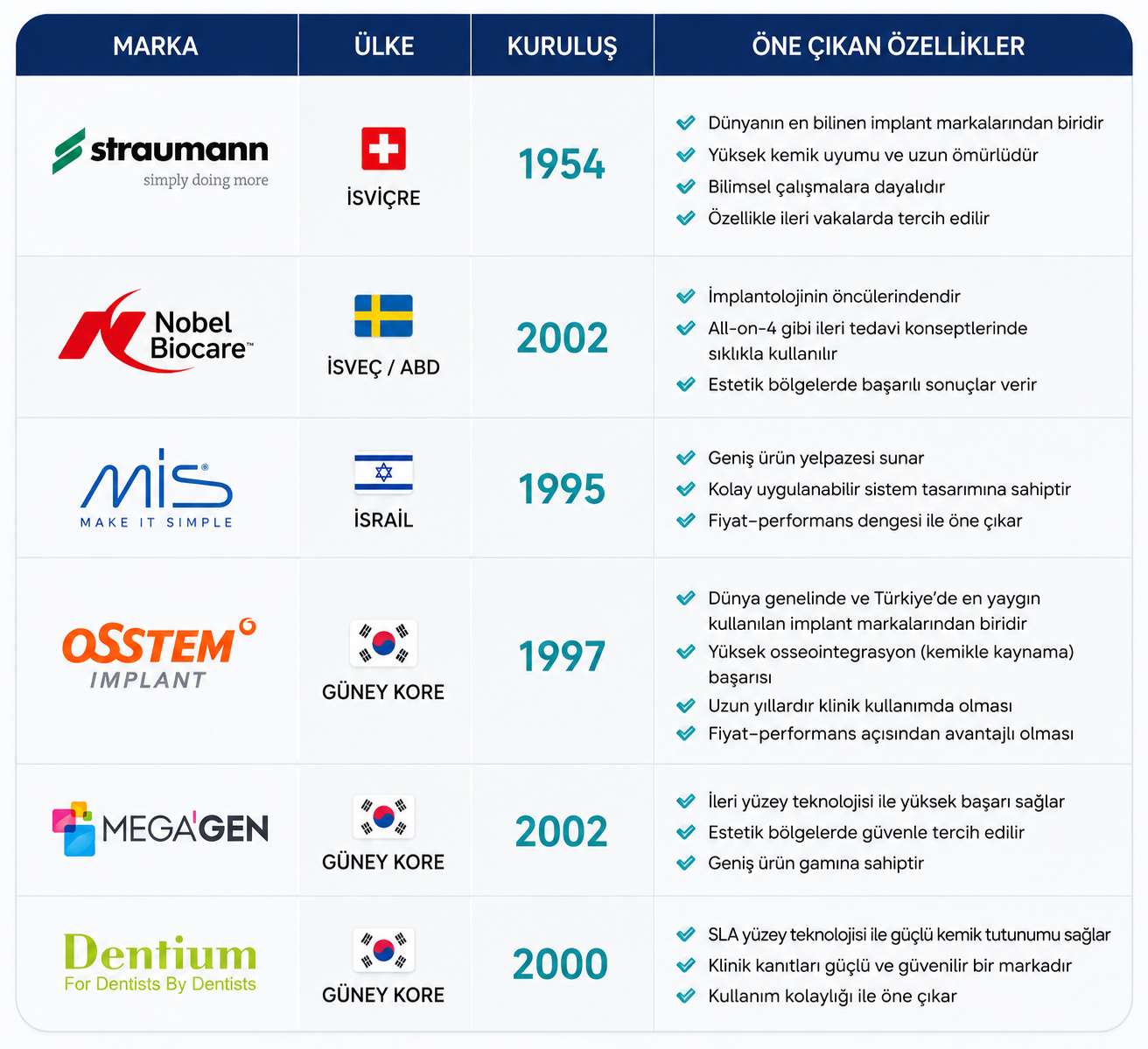
Patients considering dental implant treatment often ask the same question: Which dental implant brand is the best?
There are many implant manufacturers from countries such as Switzerland, Germany, South Korea and other parts of the world. However, choosing a dental implant should not be based solely on the country of manufacture or the brand name.
There is no single implant brand that can be considered the "best" choice for every patient. A successful implant treatment depends on several factors, including the patient's bone structure, the area where the implant will be placed, treatment planning, surgical technique and the prosthetic restoration.
Does the Dental Implant Brand Matter?
Yes, the implant system used is important, but the brand is only one part of the treatment.
When evaluating an implant system, factors such as clinical documentation, manufacturing quality, implant surface characteristics, prosthetic options and the long-term availability of components should be considered.
A well-known brand alone cannot guarantee successful treatment.
Swiss, German or Korean Dental Implants: Which Is Better?
Patients frequently encounter implants described according to their country of origin, such as Swiss, German or Korean implants.
Country of manufacture alone does not determine whether an implant is suitable for a particular patient.
Different manufacturers offer various implant designs, surface technologies, prosthetic connections and treatment options. Some systems may be particularly useful in specific clinical situations, while another system may be more appropriate for a different patient.
For this reason, it is more useful to ask "Which implant is suitable for my case?" rather than simply "Which country makes the best implant?"
What Should Be Considered When Choosing an Implant?
Several factors should be evaluated when selecting an implant system:
- Clinical evidence and reliability of the implant system
- Quality and quantity of the patient's bone
- Position of the missing tooth
- Implant diameter and length required
- Implant surface and design
- Prosthetic connection options
- Availability of original prosthetic components
- Long-term support from the manufacturer
- Experience of the clinician with the selected implant system
The implant should therefore be selected as part of the overall treatment plan rather than as an isolated product.
Is an Expensive Implant Always Better?
A higher price does not automatically mean that an implant is the best option for every patient.
The cost of an implant can be influenced by the manufacturer's research and development, production standards, distribution network, prosthetic components and brand positioning.
These factors can be important, but the most expensive implant cannot compensate for inappropriate case selection or inadequate treatment planning.
Likewise, treatment should not be selected solely because an implant system is less expensive.
Why Is Treatment Planning More Important Than the Brand Name?
Dental implants function within a biological and mechanical system. Successful treatment therefore depends on much more than the implant fixture itself.
Before treatment, the dentist may need to evaluate:
- available bone volume,
- bone quality,
- gum and periodontal health,
- neighbouring anatomical structures,
- bite forces,
- the planned position of the final tooth,
- and the type of restoration that will be placed on the implant.
In appropriate cases, three-dimensional imaging can provide additional information for treatment planning.
The objective is not simply to place an implant into the bone, but to plan an implant-supported tooth that is functional, maintainable and appropriately positioned.
Can Different Implant Brands Have Different Advantages?
Yes. Implant systems can differ in their macro-design, surface characteristics, connection types, drilling protocols and prosthetic components.
These differences may influence which system a clinician prefers in particular situations.
For example, bone density, available bone volume, aesthetic requirements and the type of prosthetic restoration can all affect implant selection.
This is another reason why there is no universal implant brand that is ideal for every patient.
Which Dental Implant Is Right for Me?
The most appropriate implant can only be determined after evaluating the individual clinical situation.
A dental examination and, when indicated, radiographic or three-dimensional imaging allow the dentist to assess the bone and plan the position and dimensions of the implant.
At Ante Dental Clinic in Nilüfer, Bursa, implant treatment is planned individually according to the patient's oral condition, bone structure and prosthetic requirements.
Rather than selecting an implant based solely on its brand or country of origin, the aim is to choose an implant system appropriate for the overall treatment plan.
Please note: This article provides general information and does not replace a clinical examination, diagnosis or personalised treatment plan.