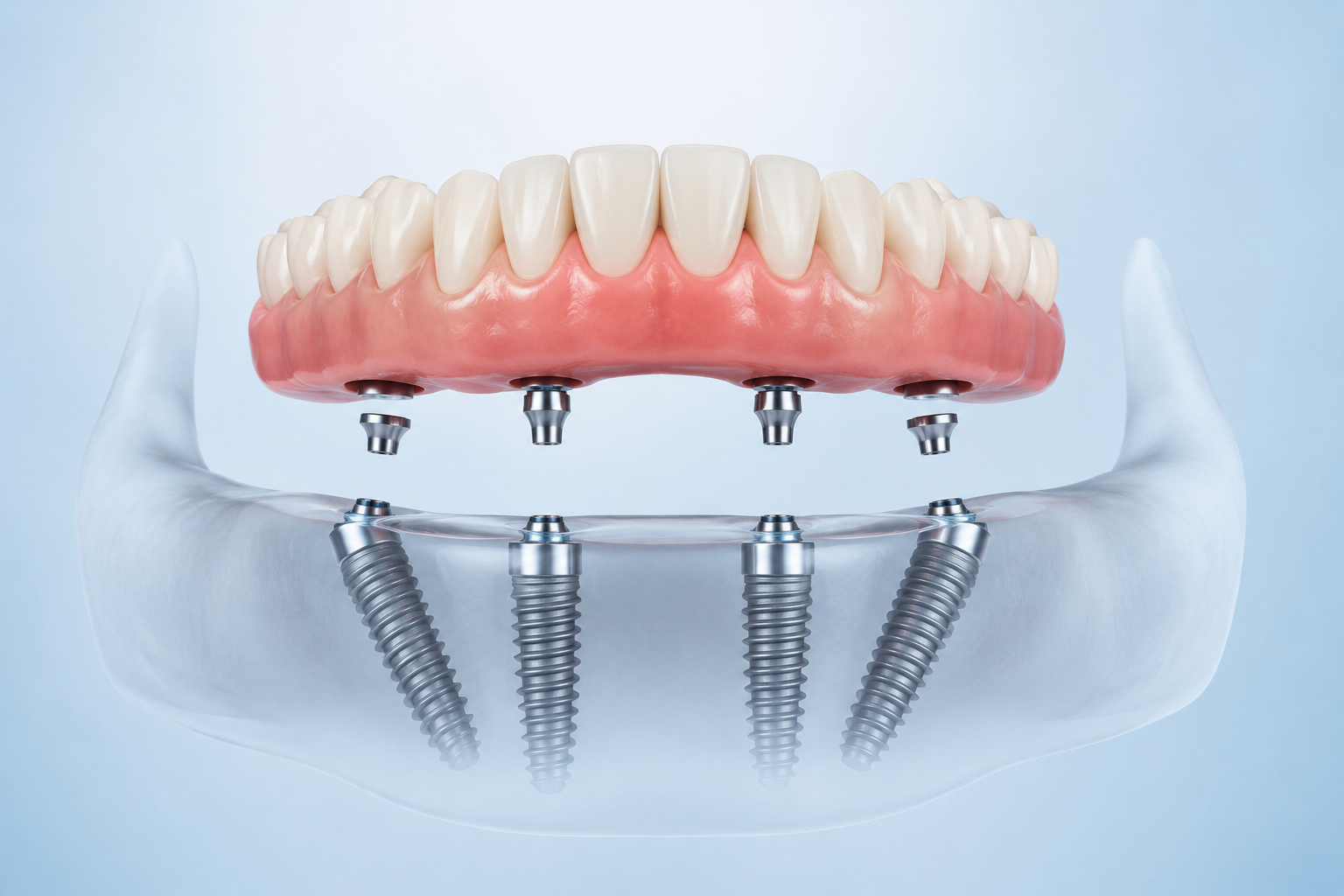
All-on-4 is a treatment concept designed to restore a full arch of missing or severely compromised teeth using four strategically positioned dental implants.
It can be considered for patients who have lost most or all of their teeth, as well as selected patients whose remaining teeth cannot predictably be maintained.
One of the main advantages of the All-on-4 concept is that a fixed full-arch restoration may be supported with a relatively limited number of implants. In appropriately selected cases with sufficient implant stability, a temporary fixed restoration may also be possible shortly after implant placement.
However, immediate fixed teeth are not suitable for every patient. Bone quality, implant stability, bite forces and general clinical conditions must be evaluated individually.
What Is the All-on-4 Concept?
In a conventional full-arch implant treatment, a larger number of implants may sometimes be used to support a fixed restoration.
The All-on-4 concept uses four implants to support a complete dental arch.
Typically, two implants are positioned more vertically in the anterior region, while the posterior implants may be placed at an angle.
Angling the posterior implants can help make use of available bone and may reduce the need for more extensive bone augmentation procedures in selected cases.
However, the number and position of implants should always be determined according to the patient's anatomy and prosthetic treatment plan.
Who May Be Suitable for All-on-4 Dental Implants?
All-on-4 treatment may be considered for:
- patients who have lost all teeth in one or both jaws,
- patients with multiple severely compromised teeth,
- patients currently using removable complete dentures,
- selected patients with reduced posterior bone volume,
- patients seeking a fixed alternative to removable dentures.
Suitability cannot be determined from missing teeth alone.
Bone quantity and quality, gum health, systemic health, smoking, bite forces and the planned prosthetic restoration should all be considered before treatment.
Do All Remaining Teeth Need to Be Extracted?
Not necessarily.
The decision to remove a tooth should be based on its individual prognosis.
Teeth with a reasonable long-term prognosis should not automatically be extracted simply to perform an All-on-4 treatment.
However, if the remaining teeth have severe periodontal disease, extensive structural damage or another condition that makes their long-term preservation unpredictable, extraction and full-arch rehabilitation may be considered.
The treatment plan should therefore be based on preserving maintainable natural teeth whenever appropriate while providing a predictable overall rehabilitation.
How Is All-on-4 Treatment Planned?
Treatment planning generally begins with a detailed clinical examination.
Depending on the case, the evaluation may include:
- examination of the teeth and gums,
- assessment of the patient's bite,
- panoramic radiography,
- three-dimensional CBCT imaging,
- digital or conventional impressions,
- evaluation of smile line and facial support,
- planning of the final prosthetic restoration.
Three-dimensional imaging can be particularly useful for assessing available bone and important anatomical structures.
Implant positions should ideally be planned according to both the available bone and the intended position of the final teeth.
Why Are the Posterior Implants Angled?
One characteristic of the All-on-4 concept is the possibility of placing the posterior implants at an angle.
This approach can help utilise available bone while avoiding certain anatomical structures.
In the upper jaw, treatment planning may need to consider the maxillary sinus. In the lower jaw, the position of the inferior alveolar nerve is important.
Angled implant placement can also increase the anterior-posterior spread of implant support for the prosthesis.
However, angled implants are not required in exactly the same way for every patient. Implant positioning should be based on individual anatomy and prosthetic requirements.
Is Bone Grafting Necessary for All-on-4?
One reason the All-on-4 concept is used is that it may allow clinicians to utilise the patient's existing bone more effectively.
In selected cases, this can reduce the need for extensive bone grafting.
However, All-on-4 does not mean that bone grafting is never necessary.
Severe bone loss, anatomical limitations or other clinical factors may still require additional procedures or a different treatment approach.
This can only be determined after clinical and radiographic evaluation.
Can I Have Fixed Teeth on the Same Day?
In appropriately selected cases, a temporary fixed full-arch restoration may be connected to the implants shortly after surgery.
This is commonly referred to as immediate loading.
However, same-day fixed teeth cannot be guaranteed for every patient.
An important requirement is adequate primary stability of the implants at the time of surgery.
The decision may also depend on:
- bone quality,
- implant stability,
- distribution of the implants,
- bite forces,
- opposing teeth,
- parafunctional habits such as bruxism,
- and the design of the temporary restoration.
If adequate conditions for immediate loading are not present, a delayed loading protocol may be safer.
Are Same-Day Teeth the Final Teeth?
Usually not.
When immediate loading is performed, the restoration fitted shortly after surgery is generally a temporary prosthesis.
Its purpose is to provide function and aesthetics while the implants integrate with the surrounding bone.
After the healing and osseointegration period, the implants and soft tissues can be reassessed and the definitive prosthesis can be planned.
The materials and design of the final restoration may vary according to the clinical situation.
How Long Does All-on-4 Treatment Take?
The surgical stage may often be completed within a relatively short period, but the entire treatment process is longer because the implants require time to integrate with the bone.
The healing period varies according to factors such as:
- jaw and bone quality,
- implant stability,
- whether additional procedures were performed,
- general health,
- smoking,
- and individual healing response.
After appropriate healing, the definitive prosthetic stage can begin.
For this reason, patients should distinguish between receiving a temporary restoration shortly after surgery and completing the entire All-on-4 treatment.
Is All-on-4 Treatment Painful?
Implant surgery is generally performed under local anaesthesia.
With adequate anaesthesia, sharp pain should not normally be felt during the procedure, although patients may notice pressure or vibration.
After surgery, temporary swelling, tenderness and discomfort can occur.
The amount of postoperative discomfort varies according to the extent of surgery and the individual patient's healing response.
All-on-4 or Removable Dentures?
Traditional complete dentures are supported primarily by the gums and underlying tissues and can be removed by the patient.
An implant-supported fixed full-arch restoration is supported by dental implants and is not removed by the patient for routine daily use.
Potential advantages of a fixed implant-supported restoration may include:
- increased stability,
- improved chewing function,
- absence of denture movement,
- a more fixed sensation during everyday use.
However, implant-supported restorations require appropriate oral hygiene and professional maintenance.
They are not maintenance-free simply because they are fixed.
How Do You Clean All-on-4 Dental Implants?
Daily cleaning is essential for maintaining the tissues around the implants.
Patients may need to use a combination of:
- an appropriate toothbrush,
- interdental brushes,
- floss designed for implant-supported restorations,
- and other cleaning aids recommended by the dental team.
The area underneath the full-arch prosthesis requires particular attention because plaque and food debris can accumulate there.
Regular professional examinations and maintenance visits are also important.
How Long Do All-on-4 Dental Implants Last?
There is no fixed lifespan that can be guaranteed for an implant-supported full-arch restoration.
Long-term outcomes are influenced by many factors, including:
- oral hygiene,
- smoking,
- periodontal history,
- systemic health,
- bite forces and bruxism,
- implant position,
- prosthetic design,
- and regular maintenance.
The implants and the prosthetic restoration should also be considered separately. Even when the implants remain healthy, components of the prosthesis may require maintenance, repair or replacement over time.
Is All-on-4 Always the Best Choice for a Full Arch?
No.
All-on-4 is one treatment concept among several options for full-arch rehabilitation.
Some patients may benefit from four implants, while others may be better treated with a different number or distribution of implants.
Available bone, anatomical conditions, prosthetic requirements and individual risk factors should determine the treatment approach.
The goal should not be to fit every patient into an All-on-4 protocol, but to select the treatment that is appropriate for the individual clinical situation.
All-on-4 Dental Implants in Bursa, Turkey
Patients considering full-arch implant treatment require comprehensive evaluation before deciding on the number and position of implants.
At Ante Dental Clinic in Nilüfer, Bursa, implant treatment planning includes evaluation of the available bone, anatomical structures, remaining teeth and the planned prosthetic restoration.
When indicated, CBCT imaging can be used to assess the jaws in three dimensions and assist with implant positioning.
Whether All-on-4, another full-arch implant configuration or a different treatment approach is more appropriate should be determined individually.
Frequently Asked Questions
Does All-on-4 really use only four implants?
The traditional All-on-4 concept uses four implants to support a full arch. However, not every full-arch case should automatically be treated with four implants.
Can I receive temporary fixed teeth immediately?
It may be possible when adequate implant stability and appropriate clinical conditions are achieved. It cannot be guaranteed before evaluating the case and implant stability.
Are the teeth fitted on the day of surgery permanent?
Usually they are temporary restorations. The definitive prosthesis is generally planned after an appropriate healing period.
Does All-on-4 require bone grafting?
Not in every case. The technique can sometimes reduce the need for extensive grafting, but additional procedures may still be necessary depending on the available bone.
Can All-on-4 be performed in both jaws?
It can be considered for either the upper or lower jaw, and selected patients may receive full-arch treatment in both jaws. Each jaw must be evaluated individually.
Is All-on-4 better than six implants?
Neither approach is universally better. The appropriate number and position of implants depend on anatomy, bone quality, prosthetic requirements and individual risk factors.
Conclusion
All-on-4 can provide a fixed full-arch treatment option for appropriately selected patients with extensive tooth loss.
Its main advantage is the ability to support a complete dental arch with strategically positioned implants and, in selected cases, potentially provide a temporary fixed restoration shortly after surgery.
However, successful treatment depends on appropriate patient selection, implant stability, prosthetically driven planning and long-term maintenance.
A detailed clinical and radiographic assessment is therefore necessary to determine whether All-on-4 is the appropriate treatment or whether another full-arch rehabilitation approach would be preferable.
Please note: This article provides general information and does not replace a dental examination, diagnosis or personalised treatment plan.